I don’t know if I ever mentioned this, but I wrote a book about Pasiphaë, taking apart the nasty Greek myth and putting it back together in a plausible historical context. Legend Press are publishing it next February, and it’s currently on promotional pre-order at Waterstones. Offer runs until the 19th, so anyone in the UK who’s tempted, you have another 24 hours.
I haven’t been keeping up with this blog lately. Too many other commitments that eat away at my time. I have missed two weeks of the Oracle’s advice and will remedy that as soon as I get a minute.
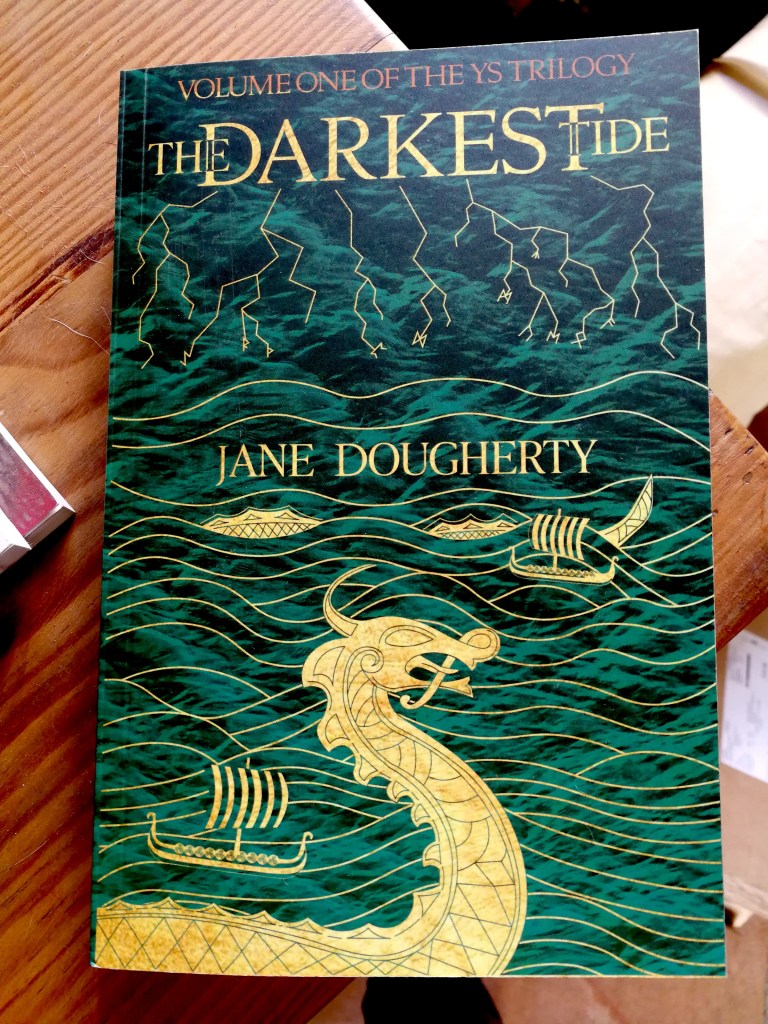
In the meantime, this is an excerpt from The Darkest Tide, introducing one of my favourite (despite appearances) characters, Arawn, the misbegotten High King.
If the excerpt intrigues, you can get hold of the book on Amazon. I won’t put in the links but just look for The Darkest Tide, Book I of the Ys trilogy.
Arawn stood in the shadows of the bedchamber listening to the laboured breathing of his son. Aeron was eighteen years of age, his father’s unopposed successor as High King, and Arawn knew, as surely as he knew that the sun set in the west, that his son was dying. Healers bustled about his bed, laying poultices of herbs on the blackened flesh, making healing spells, thickening the air with the slow combustion of foul-smelling plants. But the boy was dying. Arawn had seen it happen too often to pretend otherwise. Th e curse of the Fomhóire, they called it, and it had no cure. The boy moaned, a pathetic, feeble noise, as if he had not the strength to cry out his real pain, and Arawn turned sharply on his heel, grinding his teeth to stop the tremor of his mouth. He strode through the dark, smoky hall and out into the fresh spring air, relieved to get away from the smell of decaying flesh. The High King’s house was built in the manner of the country, wood-framed and high-beamed. But, unlike the houses of the petty kings, the interior was divided into separate chambers, dark and airless and strangely damp. Privacy was something the common people seemed not to appreciate, but the Fomhóire and those descended from them had never been able to rid themselves of their dislike of communal living, the smells of enclosed humanity, the heat and noise, the heaped piles of furs, the dogs rooting among the leavings, and the constant clamour of warriors and children as they clattered in and out of the halls. An ancestral repugnance for humanity remained among the chaos of all that Arawn had acquired from the mingling of bloodlines. The Fomhóire were eternal – sluggish, plodding, mindless certainly, but eternal. Nothing disturbed the course of their existence, no fears, no thoughts but to serve their master. Except for misadventure, they would trudge the earth forever. But by Arawn’s time, those first Fomhóire were long dead. Their creator had never intended they should reproduce themselves, never intended they should have any control over their destiny. They sowed forbidden seed, and they dwindled to shrivelled bags of sea debris. In their descendants, the mingling of human blood, with its sparks of magic, its weaknesses and self-doubt, anguish and longing, had produced creatures both more and less than their forebears. The descendants of the giants from the sea had rid themselves of unthinking service to a despotic master, they thought their own thoughts, content to walk the earth as masters in their own right. But their immortal blood was diluted, tainted with the ephemeral nature of human blood, and what precocious old age did not reap, the black flux took. Arawn ground his teeth in anger at fate that had set him before a board where the moves of the pieces were preordained, where he was condemned to lose. The morning was dull, and clouds hung low and full of rain. The cold, salt-laden wind whipped over the cliffs with its scents of the deep ocean, and Arawn filled his lungs greedily. Standing on the stone wall that circled the rath, he could look down on the heaving ocean, see the fountains of spray as each wave crashed against the cliffs. His pale eyes, colourless and dull in the light of the sun, reflected the steely grey-green of the deep water, his skin and hair different tones of the shallows, of weed streamers and grey sand. The nostrils of his broad, snub nose dilated as he breathed deeply, his thin line of a mouth parted slightly, like a man saved from drowning. Coarse hair twisted through with gold and copper wire hung stiff and still, and only the fringe of his light wool cloak fluttered slightly in the wind. The High King’s ringfort was perched on the sea cliffs; the ocean battered against it on the seaward side. On the other, a patchwork of broken rocks, whin and ling gave way to a green plain that stretched inland as far as the eye could see. In the south, the green carpet wrinkled over a string of low hills, and in the north, the green gave way to purple, then black, as the land rose sharply into gloomy mountains, their heads wreathed in cloud and grey veils of rain. As Arawn watched, a group of riders came into view from the north, their horses running with the plodding, tireless gait of Fomhóire mounts, both horses and riders stark black against the steely backdrop of the barren mountains. A shadow moved from the eaves of the hall and a clansman came to join him on the wall, his short cloak tugged by the wind, lank hair of a pale, lustreless brown whipped across his face. ‘How is the boy?’ ‘The same.’ Arawn took a deep breath. ‘Still dying.’ The clansman kept a short, respectful silence, then pointed to the approaching riders on the plain below. ‘Mac Lochlainn. He should be bringing something to raise your spirits.’ The High King turned, his pale eyes, too wide-set in his toobroad face, glinted dully in a sign of anger. ‘You have sons, Darrach, have you lost even one of them?’ Darrach shrugged. ‘At birth, one perhaps.’ ‘Can you not imagine what it’s like to lose them all? Aeron should have lived. I thought, after eighteen years… I would give all the milk-white girls in the kingdom to be able to keep just one of my sons.’ ‘But I have little of the sea people’s blood in me. ’Tis the strength of the father’s sea blood that makes the birthing hard on the women. Unless they are half sea folk themselves. Maybe Mac Lochlainn’s kin will foil the curse and give you one that will live. They’re mountain folk, and if the girl’s like her kin, she’ll be strong. She might even survive the birthing. I’ve known mountain women bear babaí of a monstrous size —’ ‘Spare me the details of your prize heifers! Has she the blood of the sea people in her veins, this mountain girl? If not, however Talannach she may be, you know as well as I do what will be the outcome.’ Darrach shrugged again. ‘The Ó Lochlainn are loyal, wellbred people – a kinswoman of theirs has every chance of carrying sea-dwellers’ blood.’ Arawn’s eyes narrowed as he watched the riders, close enough now to distinguish the smallest, slightest rider, a single splash of white in their midst, half-hidden by the flying black cloaks and hair of the escort. ‘Let’s hope you’re right, Darrach. I am weary of waiting. This is the last one of your stubborn stock I will try.’ ‘She’s not the only sheep on the¬—-’ ‘Enough! I must have sons. I will have sons, even if I have to bed half the Northlands to get them.’ ‘Tír Thuaidh?’ Darrach raised an eyebrow. ‘What do you want with those ill-dressed barbarians?’ ‘Those ill-dressed barbarians are docile as pigeons. They hand over their talented children to their Keepers without a murmur. The Northlands are awash in what they call seerlore, and my ignorant codfaced cousins have not the least idea how to use it. I will have that power, Darrach. I will take every one of their odd-eyed womenfolk if I have to, and I will get sons on them.’ Darrach sniggered. ‘Is it heirs you want, Arawn, or an army?’ Arawn turned his dull eyes on his clansman, a glare that reflected the dim light of the shallows. ‘I and my sons will rule this broken world. The Beast will never have it. It has made me neither fish nor man, and though I live in a king’s hall, instead of progeny, I engender only the black flux. I will take the power the ancients used to enchain the Beast, and I will snatch this world from it, Darrach. I will spit in its face before I crush it entirely.’ ‘And should their Talannach blood prove as feeble as our own, and…’ ‘I will not watch my line dwindle to the level of rustic chieftains, wallowing in black blood and useless female get with the faces of mackerel! I will destroy it all, and the Beast will watch, helpless. But if I win, I win eternity for me and mine. Will you take the wager with me?’ ‘To lay waste to Tír Thuaidh and enslave the barbarians?’ Darrach’s sullen face shone with a flicker of excitement. ‘I will. You will get your magic, Arawn, and who knows? It might even work.’
From contemporary Bordeaux and Picardy to Mussolini’s Rome, from the present-day vineyards of Sauternes to wartime Tuscany, Medieval Naples and a fortress in Gascony, the same story repeats itself. It echoes back and forth, in half-remembered faces, among the emblems of a forgotten house, the tumbled stones of a ruined château, by a dark river at dusk, in a betrayal. Caught in the meanders of time, a host of Alines and Dianas, Alexandres and Louis play out the tragedy of one woman. The woman is Verdiana, and she is eternal.
Verdiana
Aline’s fingers riffled along the spines of books she had no interest whatsoever in reading. The touch of leather was smooth, cool, but mostly the bindings were a grainy sort of cloth, between canvas and cardboard. Dusty and dull. Her fingers slowed, lingered on the spine of a leather-bound volume. It was the colour of walnuts with the same watery markings, and the title was stamped in gold. Verdiana. Verdiana slid from its place on the shelf, slipping neatly into her hand as if it owned it. Warm. Something whispered. A nondescript shrub tapped against the window. She ignored it. Most of the bushes in the garden could do with a good pruning. It was summer, a warm day, but nobody ever thought to open the windows in this house. The air was stale with a faint scent of tobacco and eau de roses. The title rang bells. She could almost hear them ringing. Or tolling. The name was oddly familiar, and curiosity stirred. A mystery on the point of being revealed? Aline opened the book. The paper was thick, discoloured, the print greying, type-face small. She let the pages turn, fluttering, releasing their own faint perfume that she couldn’t put a name to. She frowned. It reminded her of something. The fluttering stopped, like a bird settling its wings, at a folded sheet of very fine paper, so fine, she could see the marks made by a steel nib. Nobody who finds an old letter in an old book can resist opening it, especially not someone as bored as Aline. She turned it over. A name was written on the back fold. Aline. Was she intrigued? Uneasy? Probably no more than curious. She unfolded the note with difficulty. It had been too long pressed between the pages of the book, the fold was knife-sharp, the paper reluctant to be parted from its other side.
Meet me at the jetty tonight at sunset.
There was no signature, just a sort of flourish that might have been intended to be a flower, a rose perhaps. Instead of disappointment that the note was so short and unrevealing, Aline felt her heart beat quicken with excitement. Had that unknown Aline gone to her assignation? The note wasn’t dated, but she knew without knowing, that the unknown Aline was long dead. The shrub tapped at the window again, and the paper in her hand whispered in reply. She folded the note, slipped it back between the pages and made to replace Verdiana on the shelf. The movement stopped, and instead she placed the book on the table in the window. Dapples of moving leaf shadows played across the gleaming walnut leather, and an image of the jetty, overhung with willow and alder trees, appeared behind Aline’s eyes. The river water was deep and green, splashed with gold in the setting sun. A rowing boat was tied up, still as a heron, waiting. “I’ll go,” she said aloud. Outside, in the lime tree, a jay laughed.
I’m feeling euphoric today. I have just begun revising the novel I started to make notes for in January before shelving it as not worth the effort. With so many finished, revised, rewritten and polished manuscripts that have never found a home, it seemed masochistic to write another big disappointment. When I had a manuscript accepted for publication in September, I found the confidence to pick it up again. Maybe I could pull the same trick twice. It has been a complicated story to write, with different chronologies and threads set in several different historical periods (and places) so it was slow going. I wasn’t sure how each part was going to end, and how they were all going to be tied together right up until the last minute. Like this morning. Well, they did, and the hard work is over. Now for the fleshing out and adding of details. I might post some excerpts, if I can find pieces that make sense on their own.

 The Four Swans