Yesterday a friend suggested I join Substack. Well, I’ve been fiddling around with it, have no idea what I’m doing, but have just published my first post
If anyone reading this is on Substack, how about friending me or whatever they call it.
Yesterday a friend suggested I join Substack. Well, I’ve been fiddling around with it, have no idea what I’m doing, but have just published my first post
If anyone reading this is on Substack, how about friending me or whatever they call it.
A 144 word flash fiction for dverse, including the line:
Snow would be the easy
way out
The opening line of November for beginners by Rita Dove.
And what if?
The cabin was a fairy tale. In summer, sunlight would have slanted through the tall trunks in bright shafts, red as the deer and squirrels that slipped away into the shadows The winter trees though were black, and once the sun went down, the silence and the darkness were complete. Except for the animal cries, hunting owls, the distant howling that made them shiver, then laugh.
The temperature had dropped after nightfall, but they got the stove working, and pretended the cabin was cosy. But she pointed out that there wasn’t much wood.
‘We’re not staying long,’ he joked. ‘Name one reason for not moving on tomorrow.’
‘If you’re looking for a nightmare scenario, I imagine snow would be.’
‘The easy way out.’ He waved his phone. ‘Call for help.’
He glanced at it, his thumbs working frantically. His face turned white. No signal.
My first thought was, there is no way anyone would come out with a phrase like that. But maybe some ‘one’ might.
For the dverse prompt. The line of poetry to include in the 144-word text is:
“To be pretty for you I have dropped two seeds of turnsole in the dark of both eyes.” from the poem “Garden” by Isabel Duarte-Gray.

A gift
Fox followed the corn rows. The setting sun caught in the papery leaves, turning them gold. His ears twitched, disliking the rustling sound they made in the breeze, almost like human whispering. He listened, sniffed. There was someone there, among the stalks, someone crouching low, still, hoping not to be seen. But he could smell, the fat, juicy smell of rabbit.
Fox crept closer. He had seen the ear-twitch, smelled the tremor of fear. He stalked, circling, tasting fear turning to panic. Tongue lolled, noisily. The rabbit bolted. He was ready. It takes so little to frighten them to death.
He took his kill back to the earth, to Vixen and the cubs.
‘Although you don’t need it to be pretty, for you, I have dropped two seeds of turnsole in the dark of both eyes.’
Vixen licked his face, watching the cubs eat.
The dverse prosery prompt, was to write 144 words of prose including these lines from Seamus Heaney:
‘Traffic holding its breath,
Sky a tense diaphragm’
I couldn’t (wouldn’t) do it. The two images are Heaney’s, unique, and don’t belong in a bit of flash fiction I might write. I’ve used the two images, but not repeated them verbatim in this 144-word piece.

Sulphur
Perhaps the wind was from the wrong direction, but there was no sound of traffic from the distant town, as if everything, even the birds, was holding its breath. The sky pressed down, oppressive with its lid of oddly formed clouds, ash-grey hummocks like inverted slag heaps, sinking lower as the sky exhaled.
She covered her mouth and nose. Like sulphur, how they said hell smelled, devils. The breathless silence broke—the wail of the siren from the town. It was time to get indoors and fasten the shutters, close windows.
She ran into the thickening darkness, into the empty house and locked the door. Only as she pulled the kitchen shutter closed did she remember Biscuits. She paused, listened. On the rising wind, a cat-cry of terror, high and desolate.
‘Biscuits’, she murmured, and raced outside, into a curtain of burning rain.
My piece, We called her the mad cat woman, is up in this month’s Visual Verse. You can read it here.
For Paul Brookes’ Wildness challenge.
Decline and fall
Once so common and prolific, found on every continent, surviving in the most extreme conditions, we never imagined their decline would be so fast, so humbling. I track them now, searching for the signs, the broken branches, churned mud, the wanton waste of foodstuffs trampled by fighting males, the stink of abandoned nests.
They fear the tree zones, their senses baffled by fronds that hide predators, prefer the open spaces. Unsociable, they stick to family groups, distrust other kin groups. Strangely, they are always led by a young male. The old and experienced males and females sink to the bottom of the pyramid, unvalued, left behind when they grow too feeble to keep up, or to earn their keep. Their hierarchy changes often, young males usurp one another regularly in bloody confrontations. Most of the work is done by young females and children.
I find their tracks among the mountains of rubble and rubbish, the deserts where nothing grows, nothing lives. Some ancestral memory draws them to the smoking, dusty hills, and they dig into the filth, searching for useless things that give them wild pleasure, like magpies with their bits of glitter. I can see them now, an old male, two old females scrabbling in the dirt. Nothing else moves, though I can hear the shrill cries of a fight, the thin wailing of a hungry pup.
They will still be here, or not very far away, when I come back with the pack. Rats will eat well soon. Men are the easiest prey of all to kill.
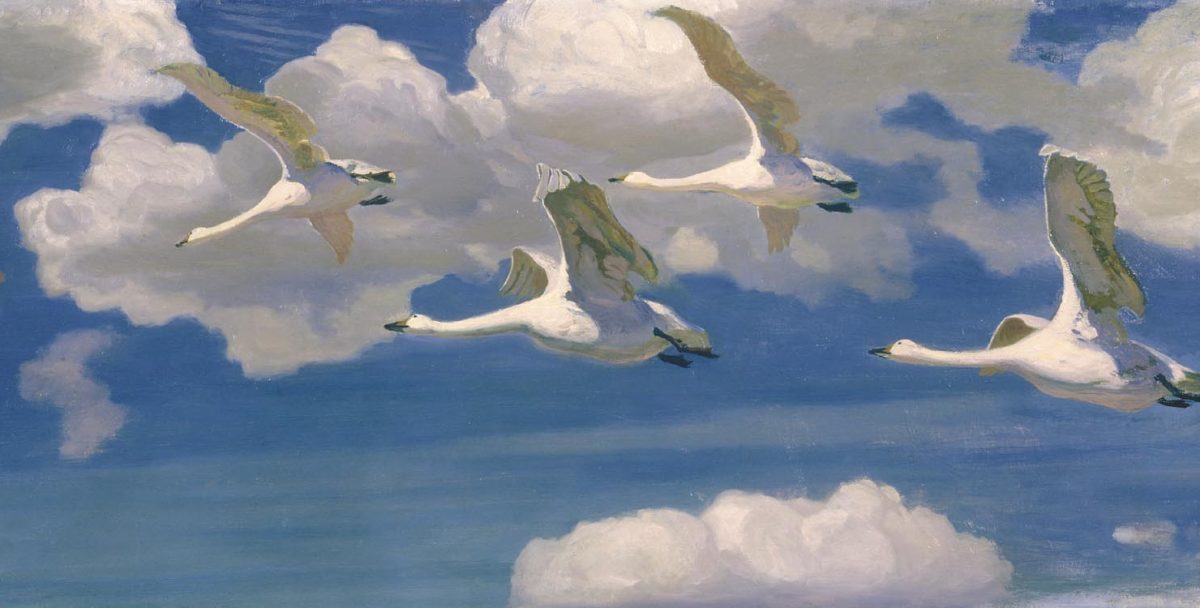
 The Four Swans