Yesterday a friend suggested I join Substack. Well, I’ve been fiddling around with it, have no idea what I’m doing, but have just published my first post
If anyone reading this is on Substack, how about friending me or whatever they call it.
Yesterday a friend suggested I join Substack. Well, I’ve been fiddling around with it, have no idea what I’m doing, but have just published my first post
If anyone reading this is on Substack, how about friending me or whatever they call it.
For dverse.
Plans
The fire burns bright now; summer is on its way, bringing children with their lives to tell and show, laughter and plans to share. We have plans, quiet ones, and a routine of caring and observing, creating what we can, tending the broken and fragile. But there will come a winter, colder than the rest, when children are far away, absorbed in their lives, creating their own laughter, and the fire will burn low, flicker, and die. Our names, clear and hot-blooded bright, will cool, fade into memories, and once all the tears are shed, will be just two of all of the names swallowed up by the cold.
There is a tree in the garden where the birds flock in spring. Among the songs, the feathers and budding leaves, I like to think you will find us there.
For the dverse prosery prompt. The line of verse by Helen Dunmore is:
‘…city lilacs
release their sweet, wild perfume
then bow down, heavy with rain.’
Judgement
‘When the time comes, you will march down to the square, where the dusty city lilacs release their sweet, wild perfume, then bow down, heavy with rain and regrets that you ever believed your plot could succeed. In the square, in the rain and the heavy scent of lilacs, with the crowd standing silent, the firing squad will end your lives. One by one, you will fall, like leaves from a dying tree, and like the leaves, when you are swept away, no one will remember you had even lived.’
The bland-faced man in the stiff uniform, who was judge, jury, god and priest rose, and for an instant, a flicker of compassion animated his dead eyes, and I knew he would carry the guilt of those deaths until his final breath.
For dverse, a piece (132 words) of prose, to include the words:
‘But that smile was the last smile
to come upon her face.’
from the poem Ballad of Birmingham by Dudley Randall. I wrote the piece before I read the poem.
A small tragedy
She couldn’t stay to talk, she said, it was time for the baby’s feed, and danced away from the gate, insouciant as a child. She turned with a careless wave, her face aglow with happiness and pride. But that smile was the last smile. To come upon her face so few minutes later, haggard and ravaged with grieving, was pitiful. I had barely got home when she called me, and I dropped everything and ran.
I arrived before the ambulance, before the little body was whisked away and antisepticised, when she still held him in her arms, the head with its crown of reddish fluff lolling, lifeless, and she, crooning like a madwoman, wordless songs as if she believed they contained some magic to bring the little scrap back from the dead.
A short piece of prose I wrote for the Ekphrastic prompt, a nineteenth century painting of Niagara Falls. You can read the successful entries here.
Games
In the clearing in front of the house, a child is playing. She sorts the leaves she has gathered in her pinafore, separates them by colours, red, orange, brown, yellow. She picks out the beetles and tosses them away. One falls into the trickle of the stream and with a pang, the leans over to fish it out, but the beetle has gone. The small tragedy clouds her play, and she abandons her leaves to blow and drift and scatter again in the gusts of wind.
Her mother is busy dying the cloth she has just cut from the loom. Her father and elder brother are fishing among the islands of the inlet. Gudrun is scouring the forest eaves for kindling, and Solveig is picking sheep’s wool from the bushes. Gerth is out of sight, minding the pigs up in the oak spinney.
The child pokes with a stick at the mud of the little rivulet, wondering about the beetle washed away. The stick makes a trench that fills with water, and she has an idea. She trots to the house and comes back with a wooden spoon, her very own spoon. Her father made it for her, with the rune of her name carved in the bowl. The beetle forgotten, she collects a few broad alder leaves for boats. She will scoop out a bay of calm water in the bank to sail them in.
Her mother, the messy job of dying finished, dries her hands, and smiles at her youngest, crouched over the stream, intent on her play. The smile vanishes when she recognises what she is using to dig into the soft mud of the bank.
‘Hilda! Stop that! A spoon’s not a plaything. What would your father say if he could see you?’
She takes the child’s arm, yanking her to her feet, and clips the side of her head. The stream water swirls about and fills the scooped out hollow. The alder leaf boats bob, circle, then slowly join the current.
In another world, below, in-between, through the clouds, a small huddle of men and women watch as the god’s fist retreats, and the crack in the sky closes, seamed with lightning. With a deafening roar, river water, blocks of stone and uprooted trees tumble over the lip of the cliff, the scoop-shaped wound left by the angry blow from the sky. The avalanche pours, wreathed in a fog of boiling steam, and the men and women run in terror from the haunted place, stopping their ears.
Above the furious pounding of the falls, filling the clouded sky, echo the maddening screams of a giant’s child.
I admit, I stared at this phrase for the dverse prompt:
You cannot pluck moonlight to bring in your pocket!
Helen Hoyt – October Letter
and did not understand it. The way the phrase is put together seems strangely un-English to me. So I wrote a golden shovel using the phrase as the end-of-line words. It took a lot more looking at it before I found a way to give the words a sort of sense to my ears.
Leaving
I stood in the half-light of the kitchen. Grandmother held my hands. Her face was a blur through my tears. ‘I don’t want to leave. Everything I love is here, you, grandda, the dogs and cats, the rabbits on the hill, our walks in the moonlight to watch them playing. If I can’t take all that, I don’t want to go.’
‘You cannot pluck moonlight to bring. In your pocket is the ticket for your passage, the key to the door of the house, a letter to give to your aunt, and a handful of earth, your earth, so you never forget where you came from. It will draw you back one day. I hope I will still be here to greet you.’
I cried then, but it was time. Thomas was in the doorway. The cart was ready, waiting. I never did return.
We two
We stand on the hill, you
and I. There is nothing we cannot
do or be. We can pluck
the stars from the sky, moonlight
from the water, twined silver to
wear in our hair. Bring
me my bow, gold-burning, in
fire notes singing, and I will be your
anthem, you the amulet in my pocket.
I am very pleased that Ekphrastic decided to publish my short story. The subject is one I have grown a bit obsessive about. Thank you Lorette for bearing with this long offering. You can read all the chosen pieces here.

Hymenaios
Naxos, the limit of Cretan territory. Beyond, the world belongs to the Hellenes. Should Ariadne pass beyond this sacred boundary, she renounces her right to the throne of Knossos. Theseus knows this, though he pretends that he is taking her to Athens to be his wife. Theseus believes that a husband is owed his wife’s birthright, that thrones are for kings not queens, that women are for taking and abandoning.
The ship put in at Naxos to fill the water casks before facing the open sea. The crew made their noisy sacrifices to their gods, and now they are sleeping. Theseus thinks she has stayed ashore alone to look one last time at the stars of her home before giving her life and her stars to him. She tosses a myrtle branch into the little fire, takes deep breaths of the smoke. It hasn’t occurred to Theseus that she might be making magic, calling upon the Mistresses to turn her fate about and release her from the stupid pact she made with him.
The smoke curls and dances, becomes misty gauze, tresses of unbound hair, the abandon of women in a trance. Ariadne does not know them for Maenads. They are not part of her culture, but they have been sent by the Mistresses, to disentangle her from this story that is now half-Greek. They sing in husky, breathless voices until they are out of earshot of the ship, and then the song explodes with shrieks of laughter, and joy that tastes of blood.
They take her hands and she follows, through groves of olive and oak, bay and myrtle, to a clearing and a pool where a dark-haired man is waiting. The women fawn, licking his name with their tongues, Dionysus, stroking his face, their nails like the claws of wild beasts. He catches at their hands roughly and pulls them away. They throw flowers, their laughter rising to a frenzy. The man smiles at her, his eyes roving, his fingers itching to follow.
Ariadne sees just another Greek, though this one claims he is a god. Can she not see?
The women laugh, leap, splash into the pool, pulling Dionysus after them. They all drink, their faces flushed red even in the moonlight. The women draw her into a dance—she is the labyrinth dancer after all—but she drinks little, watches for dawn. At first light, Dionysus stumbles to the shore where the sailors are already preparing the ship to leave.
Dionysus will send Theseus away, the women say. He will tell him you are his bride. No Greek would dare defy the desires of a god or deny his claim.
Ariadne watches him return, his gait unsteady. She smells the wine fumes even in the salt wind. He walks straight to her, and without a word, pulls her to him and kisses her on the mouth. The women shriek with laughter, as musicians appear from among the trees, shadowy and with a feral smell.
Dionysus claps his hands, a cup is placed in his fist, wine flows, sticky sweet, and through the gauze mist of the women, a youth appears, languid as a water lily, lying on the bank of the pool. He dips a toe in the water and blows a kiss to Dionysus. The women weave flowers in his hair, drape garlands about his neck. His tunic is awry, slipped over one shoulder. His skin is the colour of bronze, his lips too red and parted. Ariadne’s lip curls.
She watches Dionysus, the dance of the women. Musicians play dark, wild tunes, food appears, all wear flowers. Ariadne narrows her eyes. She wants neither Theseus nor his drunken god, but the Maenads are all around her, and she is drawn into the circle, a locked circle. At its centre, Dionysis, heavy with drink urges the boy to his sandaled feet. With a gesture of ennui, the boy reaches out a hand, and someone tosses him a lyre.
The women chant, Hymen, Hymenaios!
The wedding song! Dionysus calls out, and Ariadne wonders who is the bride. Is it herself or the painted boy, or is it the wild army of Maenads?
Sing, Hymen, and stir our blood.
The Maenads let their tunics fall to their waists, spread their arms and let gauze, limbs, hair mingle in their uncoordinated dancing. Dionysus touches Hymen’s face, raises his cup to the boy’s lips, laughs when the sweet sticky wine runs down his chin, trickles down his chest. Then he turns his attention to Ariadne. The cup is refilled, he holds it out. With his other hand he beckons to her.
The wedding cup. He grins and his teeth flash. I have sent Theseus on his way. He made no protest. Your lover is fickle, Ariadne.
‘My lover is a Greek,’ she replies, pushes the cup away, and begins her dance. None pick up the insult, none notice the thickening of the air, the Cretan air. Hymen strikes a chord on his lyre, and silence falls, all waiting to hear his voice, more lovely than the sweetest birdsong. When the first note falls to the ground, raw and rough, they imagine he is clearing his throat. None hear the growl of the Mistress’s lions.
Ariadne dances, and the feral smell grows stronger, but the musicians have slunk back among the trees. The wild women cry out as they merge with skeins of mist rising from the pool, and Dionysus grimaces, spits, and pours black blood from his cup. Ariadne dances the lion dance, sings the lion song, and Hymen, silenced, claps his hands to his mouth. Blood seeps between his fingers. Ariadne hears no more, lets the dance transport her, and when she comes to herself, evening is falling, the glade is empty, and so is the sea. For her, it will always be empty.


Stones
They walked the beach in the moonlight, feet crunching through the pebbles, the loud crash of waves on rocks silvery grey as walruses. It was cool now and they walked close, in step, hands in pockets. The beach was familiar, but neither of them noticed its familiarity. Neither noticed the moon, the sound of the waves, the rocks like walruses. They were thinking of the first time, remembering how they had walked enlaced, how they laughed. Possibly they talked but what they said can’t have been memorable.
They were thinking of that first time and all the times and tides in-between, the waves that had washed over so many shores. They had raced over so many beaches, quick and thoughtless as water. But on this one, they had left no trace. Pebbles crunched as they walked, and it was as if they have never been. She, at least, realised now, that they had never left a trace. Not here, not anywhere, not together.
She bent down, picked up a stone, roundish, flatish, palish, with a hole worn through the centre. She held it up, looked through the hole at the moon, then turned it towards his face. Her fingers curled around the stone and she slipped its smooth comfort into her pocket. Bad luck couldn’t pass through a hag stone. In the morning, she would leave. Alone.
Second version, without ‘the line’.

A gift
Fox followed the corn rows. The setting sun caught in the papery leaves, turning them gold. His ears twitched, disliking the rustling sound they made in the breeze, almost like human whispering. He listened, sniffed. There was someone there, among the stalks, someone crouching low, still, hoping not to be seen. But he could smell, the fat, juicy smell of rabbit.
Fox crept closer. He had seen the ear-twitch, smelled the tremor of fear.
He stalked, circling, tasting the tremulous fear turning to panic. He knew the animal’s nerve would break, and when it bolted, he would be ready. Tongue lolled, noisily. It was too much; the rabbit raced past. He leapt. It takes so little to frighten them to death.
He took his kill back to the earth, where Vixen was waiting with the cubs. It was warm in the earth, full of fox smell, the squealing of the young ones. Newly-sighted, they were beginning to tumble in play. He crouched beside Vixen, watching his cubs, their bright eyes.
Vixen licked his face, having no need for a spoken language, and began to eat, tearing off the tenderest bits for the cubs. Their white teeth needed training. Tender, the fur and paws, the small mewling sounds, the smell that filled the hidden world beneath the hedge.
The dream I had last night/this morning. Otherwise, I slept quite well.
The End
And it came to pass that division and sub-division splintered all the world’s societies into groupuscules, and the word unity was removed from all the dictionaries. Men had fought one another over land, then over oil and religion, historical and imagined grievances, and then over water, until the earth was criss-crossed with scars, cracked and wrinkled.
The men hunkered down behind their walls and wire, and each group brought back one of a multitude of gods to worship, and they let themselves be ruled by their god’s living representatives. Each god had his own code of laws, and the only common law was that the earth belonged to men.
So there were no more women, only birthers, no more fauna, only cattle, no more flora, only crops. There were only men to rule them, and in the words of one of their gods, in the darkness bind them.
Men had fought over the most precious resources of the earth and tainted them all. They had stolen, soiled, and spoiled everything that was beautiful in the red lust that blinded their eyes. They had diverted and dried up the great rivers, destroyed the great forests, poured concrete over the green grass, scattered the carcases of rockets, missiles and satellites through the atmosphere while populations starved. They tried to snatch the stars from the sky and failed.
There was one thing of beauty that remained, a reminder of what had been, and what could never be. Birds. They taunted the men with their freedom, their graceful, weightless dance. They sang songs that no machine could match, and they went where they would, clinging to the sky when there were no more trees.
In their rage and envy, their anger at what eluded them, so simple, so stupid, so fragile, yet so inimitable, the men united one last time. Across the world, in each tiny beleaguered nation, each miniscule city state, the priests and preachers hurled the order from pulpits, to massacre the devils in feathered form that mocked men and their heavy boots that could never leave the ground.
And when the last little body lay limp and broken on the ground, the earth gave a final shudder and made an ending.
The plaster and paint gods knew nothing, and their bewigged and bedizened mouthpieces would never have understood, that the fretwork of frail and hollow birdbones held up the coping of the sky, and birdsong was the lifeblood of the earth.
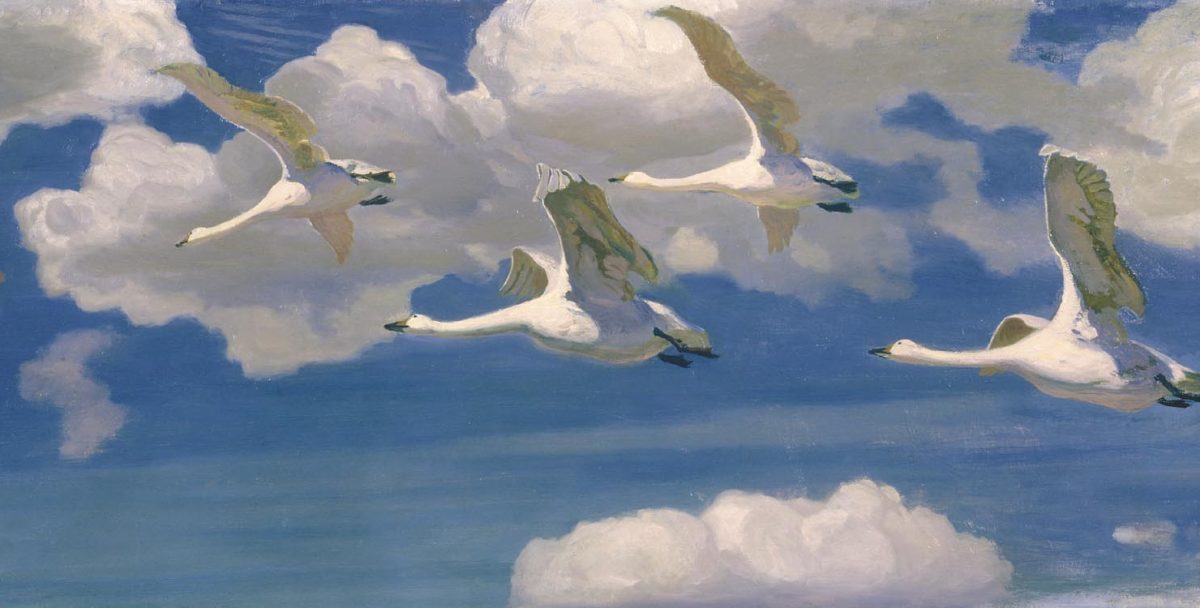
 The Four Swans